We are your trusted health partner. Local doorstep deliveries is within the hour .We are Licensed and Regulated by the Pharmacist's Council of Nigeria(PCN).Prices displayed here may differ due to inflation.
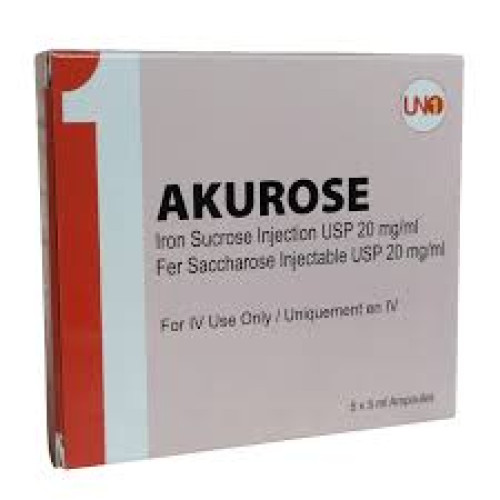
PREMIUM HIGH-PERFORMANCE INTRAVENOUS REPLACEMENT SYSTEM DESIGNED FOR RAPID, PREDICTABLE HEMOGLOBIN CORRECTION AND CELLULAR REPLENISHMENT. MANUFACTURED UNDER STRICT USP SPECIFICATIONS, SECURED COLD-CHAIN, AND DISCREETLY DELIVERED ACROSS NIGERIA AND WORLDWIDE.
Akurose contains Iron Sucrose, a sterile, aqueous colloidal complex of polynuclear iron(III)-hydroxide in complex with sucrose. This macromolecular configuration is engineered to keep the iron "caged," preventing the hazardous release of free elemental iron ions directly into the plasma.
Upon direct intravenous administration, the Akurose complex is selectively removed from circulation by the cells of the reticuloendothelial system (specifically concentrated in the liver, spleen, and bone marrow). These cells split the complex into its separate components: sucrose (which is safely excreted) and elemental iron. The liberated trivalent iron binds immediately to transferrin—the body's specialized iron transport protein—which ferries it straight to the bone marrow to act as a primary building block for creating hemoglobin, or stores it safely as ferritin for future red blood cell synthesis.
Severe Iron Deficiency Anemia (IDA): Providing high-speed clinical restoration of depleted iron stores where traditional oral iron preparations are entirely ineffective, cause severe gut irritation, or exhibit poor patient compliance.
Chronic Kidney Disease Anemia (CKD): Replenishing lost iron resources in adult and pediatric patients with kidney disease, including non-dialysis, peritoneal-dialysis, or hemodialysis-dependent individuals (frequently infused directly into the venous limb of the dialyzer).
Active Inflammatory Bowel Disease: Overcoming severe anemia in conditions such as Crohn's Disease or Ulcerative Colitis, where intestinal tracking is inflamed and incapable of absorbing oral supplements.
✅ Adults and Children (Aged 2 and Older) requiring direct, predictable intravenous correction of critical clinical iron deficits.
❌ STRICT OVERLOAD CONTRAINDICATION: Akurose must never be administered to individuals experiencing iron overload (such as hemochromatosis or hemosiderosis) or patients whose anemia is not specifically caused by an iron shortage (e.g., hemolytic anemia).
❌ Do not use if you have a known history of severe hypersensitivity, eczema, or an atopic allergy to iron sucrose or other parenteral iron complexes.
Standard Formulation Strength: Supplied as a dark brown, slightly viscous liquid containing 20mg of elemental iron per 1 mL of solution (typically presented in a 5 mL single-dose vial providing 100mg of elemental iron).
Route of Administration: Strictly via the Intravenous (IV) route. Akurose must never be given via an intramuscular (IM) injection, as this causes tissue damage, intense local pain, and permanent dark brown cosmetic staining of the skin muscle layers.
1.Verify laboratory diagnostic panels:Prerequisite.
Ensure clinical lab tests—including Hemoglobin (Hb), Serum Ferritin, and Transferrin Saturation (TSAT)—have been documented to confirm a true iron deficiency status prior to drawing up the vial.
2.Dilute strictly with normal saline:Preparation.
A licensed clinical professional must aseptically dilute Akurose solely with 0.9% w/v Sodium Chloride solution (Normal Saline). Never mix it with other medications or glucose/dextrose-based fluids, as this causes the chemical complex to degrade.
3.Initiate a slow clinical test rate:Infusion Start.
Begin the intravenous drip or slow IV push at a heavily reduced rate for the first 15 minutes (e.g., slow injection at 1 mL undiluted solution per minute). This serves as a vital clinical test window to check for early signs of systemic hypersensitivity.
4.Complete the dose and observe post-infusion:Monitoring.
Run the remaining solution over the prescribed timeframe (e.g., at least 15 minutes for 100mg, or 30 minutes for a 200mg dose). Keep the patient under direct medical observation for at least 30 minutes post-infusion to verify full circulatory stability.
💡 Never attempt to self-inject or manage Akurose at home. This medication must only be administered in a registered hospital, outpatient clinic, or dialysis center where trained staff and full, immediate resuscitation facilities are completely assured.
Iron Sucrose complex (20mg elemental iron per mL): A highly stable, pH-optimized synthetic compound engineered to mimic the body's natural iron storage transport dynamics.
Akurose is highly preferred in modern clinical practice due to its exceptional purity and significantly lower allergy profiles compared to older iron dextran models. The most common mild, transient side effects include dysgeusia (a temporary strange or metallic taste in the mouth), mild nausea, a brief drop in blood pressure (hypotension if infused too rapidly), dizziness, flushing, or minor swelling/bruising at the needle insertion site.
⚠️ CRITICAL CLINICAL CAUTION: Parenterally administered iron can rarely trigger acute, severe anaphylactic reactions (breathing difficulties, throat or facial swelling, or severe chest tightness). Furthermore, paravenous leakage must be carefully guarded against; if the solution escapes the borders of the vein into the surrounding tissue, it can cause localized inflammation, tissue necrosis, and highly persistent, dark brown skin staining. If post-dose dizziness or lightheadedness manifests, do not drive or operate heavy machinery until symptoms cease.
Pregnancy Note: Iron deficiency during the first trimester can usually be addressed via oral means. Akurose administration during pregnancy should be strictly confined to the second and third trimesters, and only when the clinical benefit is judged by an obstetrician to heavily outweigh potential risks to both the mother and the fetus.
Why does my mouth taste like metal during or immediately after my Akurose infusion?
Experiencing a temporary metallic taste (dysgeusia) is the single most common side effect reported with Iron Sucrose injections, occurring in about 4.5% of cases. It is a completely harmless, temporary physical reaction as minor amounts of the iron complex interact with salivary receptors. The taste usually fades completely within a few hours following the completion of your drip.
What happens if a patient receives too much Akurose (an overdose)?
An excess accumulation of intravenous iron can cause acute iron overloading, which can manifest as hemosiderosis (excessive iron deposition in tissues and organs). If an overdose occurs or iron storage levels rise too high (such as ferritin exceeding 500 ng/mL), active treatment is immediately paused, and your physician may initiate management utilizing an iron chelating agent to safely bind and remove the excess mineral.
How does Akurose affect oral iron tablets that I am already taking?
Receiving high-efficiency intravenous infusions like Akurose makes it significantly harder for your gut to absorb oral iron supplements. You should generally stop taking oral iron pills (like ferrous sulfate or gluconate) while receiving your Akurose injection cycle, as combining them provides no extra benefit and can increase the risk of digestive discomfort.
Do you ship clinical-grade ampoules and cold-chain protocols internationally?
Yes. We deliver batch-verified, original manufacturer-certified Akurose injections to the UK, USA, Canada, Europe, and across Africa utilizing highly secure, temperature-monitored medical shipping systems.
Is it available for express hospital delivery across Nigeria?
Yes. We supply to cold-chain verified medical facilities across all 36 states, with secure express shipping straight to clinical, corporate, or hospital pharmacy addresses throughout Lagos and Abuja via Sanlive Pharmacy to ensure your hematology care remains completely seamless.
100% genuine premium clinical pharmaceutical. Quality-verified and distributed under strict pharmaceutical safety protocols by Sanlive Pharmacy
No reviews yet — be the first!
Log in to write a review.